
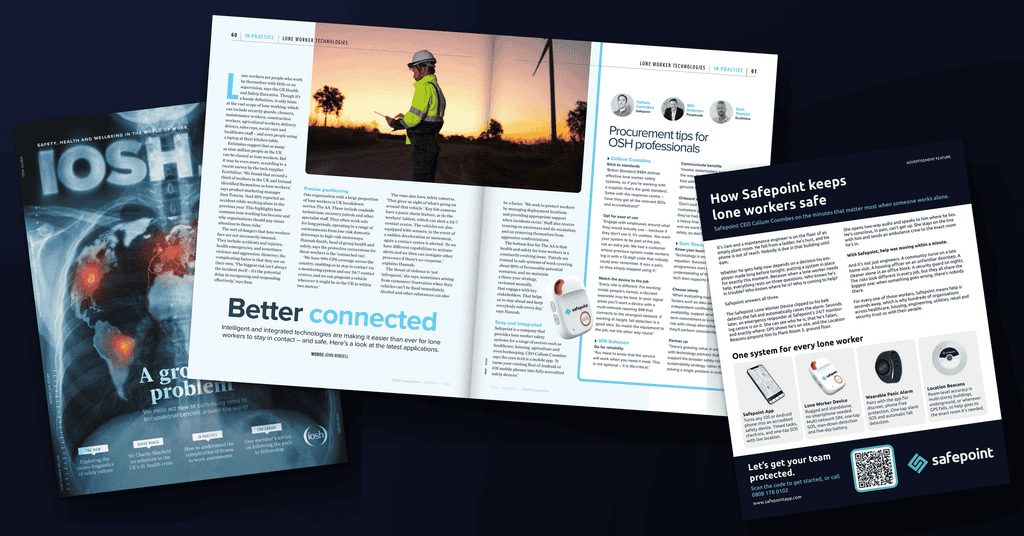
IOSH magazine’s Q4 2026 issue looks at how intelligent, integrated technology is helping lone workers stay in contact and safe. Safepoint CEO Callum Coombes was one of the industry voices IOSH asked what health and safety professionals should look for when buying a lone worker system. Here’s what he told them, and why it matters.
The Institution of Occupational Safety and Health is the world’s largest professional body for people responsible for health and safety at work, and IOSH magazine goes out to its 50,000 members every quarter. So when it asked us to contribute to a feature on lone worker technology, we were glad to. The piece, Better connected, is written by John Windell and appears in the IOSH magazine Q4 2026 issue, published in October.
It opens with the scale of the problem. Estimates put the number of lone workers in the UK at nine million or more, and a recent survey quoted in the article found that around a third of workers in the UK and Ireland identified themselves as lone workers. It then makes a point we’ve been making for years: the biggest risk to a lone worker usually isn’t the incident itself, it’s the delay before anyone notices and responds. That’s the gap a lone worker system exists to close.
If lone working is new territory for you, the HSE’s guidance on protecting lone workers sets out the employer’s duty to assess and manage the risk, our guide to what lone working is covers the definition, and our summary of lone working law and what changes in 2026 explains what you actually have to do about it.
Safepoint CEO Callum Coombes was asked what health and safety professionals should look for when procuring lone worker protection. His advice came down to three things.
BS 8484 is the British Standard for lone worker services, and it’s the benchmark any supplier should be measured against. The response centre handling your alarms should hold the relevant ISO accreditations too. If a supplier can’t show you both, keep looking.
If you want to know what the standard actually requires of a supplier, we’ve written a plain-English guide to BS 8484:2022 and what it means for lone working solutions. It’s also the standard we hold ourselves to: Safepoint’s apps, devices and Alarm Receiving Centre are all certified to BS 8484:2022.
A lone worker system only works if people engage with it, so it has to be part of the job rather than an extra job. Callum gave IOSH the example of a customer whose previous system was awkward to use, so staff simply stopped using it, which left them with no protection at all.
Engage with the people who’ll be using the system and find out what they would actually use, because if they don’t use it, it’s useless.
Every role is different. Someone working inside people’s homes needs to be able to call for help without the person in front of them knowing. The Safepoint Wearable Panic Alarm pairs with the app and sends a silent SOS with one press, so there’s nothing to say and nothing to pull out of a pocket.
Workers in poor signal areas have a different problem: a device on a single network is only as good as that network’s coverage where they happen to be standing. The Safepoint Lone Worker Device has a multi-network roaming SIM, so it connects to whichever network is strongest at that spot rather than being tied to one.
Anyone working at height, or alone in a plant room, needs a system that raises the alarm when they can’t. Both the Wearable Panic Alarm and the Lone Worker Device have automatic fall detection, which triggers an alert without the worker pressing anything.
The equipment should fit the role, not the other way round.
The article also covers Safepoint’s Location Beacons, which solve the last part of the problem: knowing where to send help inside hospitals, hotels and other large buildings where GPS doesn’t reach. A beacon gives room-level location, so help goes to the exact room rather than just the building.
Two forward-looking points from the feature are worth noting if you’re planning a lone worker safety programme for the next few years.
The first is satellite connectivity. Smartphones with satellite capability are arriving, and Callum expects them to remove the need for expensive specialist satellite devices in remote areas, because a standard iPhone or Android phone will be able to fall back on satellite when there’s no mobile signal.
The second is AI. It’s already useful for spotting trends in safety data, but Callum was clear that it isn’t yet at the point where it should be deciding whether to dispatch the emergency services. For now, AI supports human responders rather than replacing them.
Alongside the feature, the same issue carries a full page on how Safepoint works as one system: the Safepoint App, Lone Worker Device, Wearable Panic Alarm and Location Beacons, all managed from one portal and backed by 24/7 monitoring.
You can read the full feature in the Q4 2026 issue of IOSH magazine. If you’d like to talk through which setup fits your workforce, book a demo with the Safepoint team.


